
Motorsport Traditions in Latin America: The Legacy of Interlagos and Brazilian Racing
Between lakes, between eras
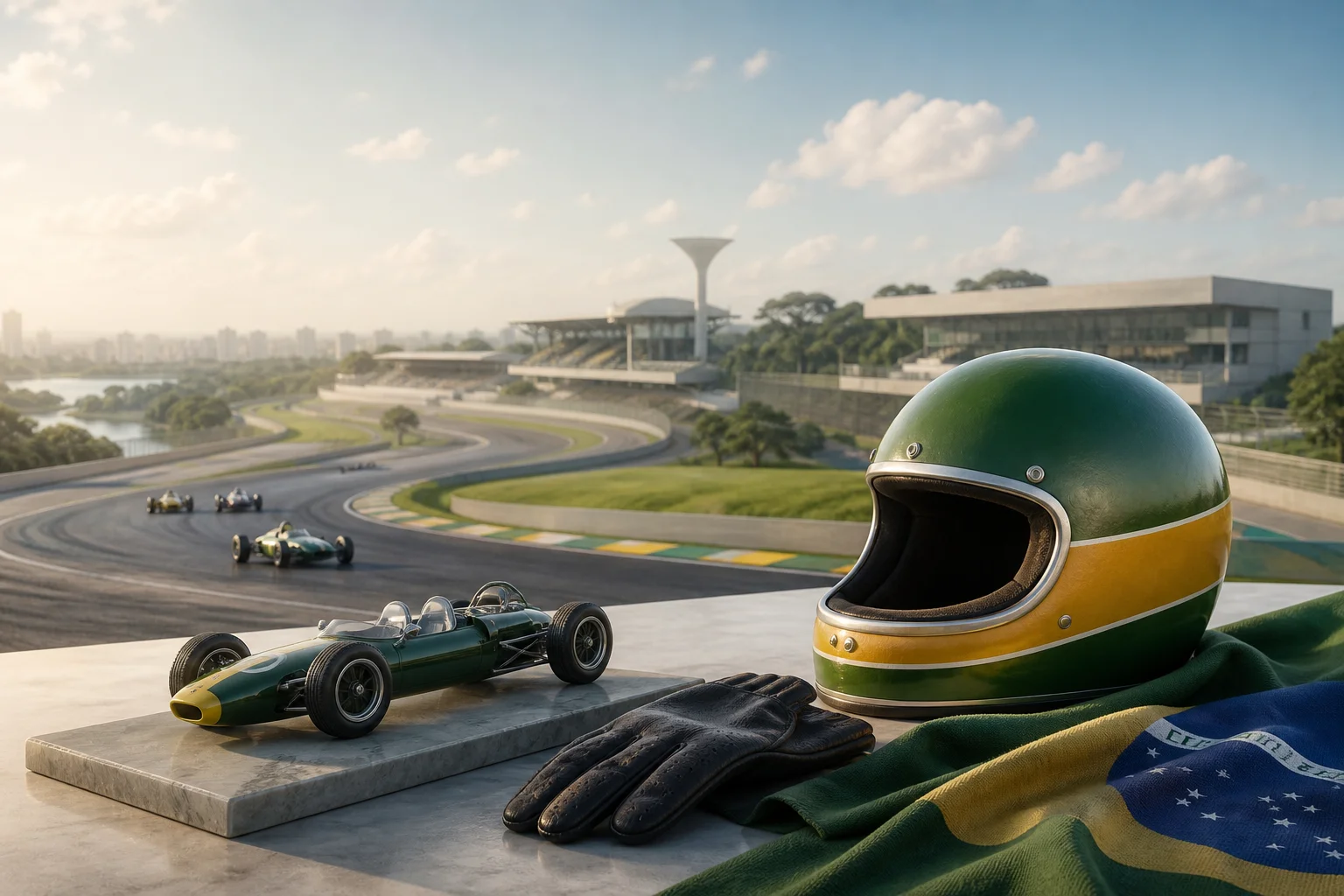
Why does a circuit squeezed between two reservoirs on the edge of São Paulo still shape how the region's racing is understood? Interlagos — Portuguese for “between lakes” — opened in 1940 on ground bordering the Guarapiranga and Billings reservoirs. A championship Formula 1 round arrived in 1973, and in 1985 the track was renamed after José Carlos Pace, the local driver who had won there a decade earlier. The lap runs anti-clockwise over 4.3 kilometres, a direction that loads the right shoulder of every tyre and punishes drivers physically. Its weight is structural rather than sentimental: the venue links the pre-war road-racing culture of São Paulo's industrial elite to a contemporary global calendar. Analysts mapping motorsport traditions in Latin America usually start here, because Interlagos compresses geography, engineering and political economy into a single short loop.
The Evolution of Brazilian Motorsport
-
Establish the circuit between reservoirs
Open the Autódromo José Carlos Pace in 1940 on reclaimed swampland bordering the Guarapiranga and Billings reservoirs. This unique geography creates the foundational anti-clockwise layout that defines Latin American racing traditions.
-
Welcome Formula 1 to São Paulo
Host the inaugural championship Formula 1 Grand Prix in 1973. This milestone event cements the circuit as the premier destination for international motorsport competition within Latin America.
-
Rename the track after José Carlos Pace
Honor the legendary local driver by officially renaming the venue in 1985. The tribute connects the physical asphalt directly to the emotional core of Brazilian racing heritage and past victories.
-
Develop domestic single-seater ladders
Establish robust regional feeder series beneath international categories. These domestic championships provide local drivers with the technical foundation needed to reach global motorsport pinnacles.
-
Compete in the Stock Car series
Race in Brazil's premier touring car category, which serves as the backbone of the nation's motorsport industry. Experienced professionals and rising talents battle on tight circuits across the country.
-
Preserve the legacy beyond nostalgia
Maintain the technical relevance of Interlagos through modern facility upgrades and championship showdowns. The circuit continues to shape contemporary motorsport strategy while honoring its historical roots.
Geography shaped the layout
Interlagos exists because twentieth-century São Paulo needed water and recreation in roughly equal measure. The land around the Guarapiranga and Billings reservoirs was earmarked for leisure, and a circuit appeared on it in 1940, drawn across ground that rises and falls far more than a flat park layout would allow. That inherited topography still dictates everything. The lap plunges through the Senna S, drags along the Reta Oposta and climbs back toward the pits through the Subida dos Boxes, so cars spend long stretches loading one side of the tyre while asking the other for traction. Drainage matters as much as asphalt: tropical summer storms turn low-lying sections into streams, and standing water has red-flagged sessions more than once. São Paulo's sprawl closed in around the perimeter, which is why the venue feels urban and enclosed rather than pastoral — a trait that separates it from purpose-built circuits on greenfield sites.
Eight titles from one country
Brazil's contribution to Formula 1 is not a single champion but a lineage. Emerson Fittipaldi took the 1972 and 1974 titles, then moved to American open-wheel racing and won the Indianapolis 500 twice. Nelson Piquet added three championships across the 1980s with Brabham and Williams, and Ayrton Senna collected three more between 1988 and 1991. Three drivers, eight crowns — a concentration few nations have matched. The pipeline did not stop there: Rubens Barrichello started more than three hundred grands prix, Felipe Massa won eleven and lost a title by a single point, and the American ladder absorbed Gil de Ferran, Tony Kanaan and Hélio Castroneves. That spread matters when reading motorsport traditions in Latin America, because it reveals a talent stream feeding several disciplines rather than one series, and it explains why karting in the interior of São Paulo state stayed a serious career route.
Core Characteristics of Brazilian Motorsport Traditions
| Track and Heritage Aspects | Technical and Regional Factors |
|---|---|
| Circuit built between two reservoirs | Anti-clockwise layout punishing tyres |
| Hosting Formula 1 rounds since 1973 | Named after local driver José Carlos Pace |
| Producing eight world championship titles | Deciding championship outcomes at the venue |
| Contrasting with Buenos Aires and Mexico City | Managing setup compromises at high altitude |
| Supporting national Stock Car racing series | Maintaining traditions beyond mere nostalgia |
Where championships have been settled
Interlagos has hosted a disproportionate share of decisive afternoons. Senna won at home in 1991 while managing a gearbox that had shed several ratios, and again in 1993 in conditions that punished every wrong call on tyres. The 2003 race was stopped early and its result took days to confirm. In 2007 and 2008 the circuit staged the final round, and the 2008 finish — a late overtake in the last corners on a drying track — decided the championship by one point. Later, the sprint format and a renamed São Paulo Grand Prix kept the venue in the headlines, including a 2021 weekend in which a disqualification forced a front-runner to climb from the back of the grid to win. The common thread is not romance but variance: altitude, weather and a short lap compress the performance gap between teams.
Buenos Aires and Mexico City add contrast
Motorsport traditions in Latin America are not one lineage but several, and the differences are instructive. Argentina produced Juan Manuel Fangio, whose five titles in the 1950s were built on long, hot races and mechanical sympathy, and the Oscar y Juan Gálvez circuit in Buenos Aires hosted championship rounds for decades. Mexico contributed the Rodríguez brothers — Ricardo, fast and short-lived, and Pedro, a durable winner — and the Hermanos Rodríguez layout sits above two thousand metres, where thin air rewrites cooling and downforce calculations. Colombia's later emergence through Juan Pablo Montoya proved the model had not closed. These venues rarely shared a calendar with Interlagos, and their funding models diverged: some leaned on state promotion, others on private promoters. The outcome is a set of national stories that rhyme without merging, so regional comparisons need care rather than a single template.
Motorsport Traditions FAQ
What defines motorsport traditions in latin america at Interlagos?
When did Formula 1 first arrive at the Brazilian circuit?
Why is the geographic placement of the circuit significant?
How does the track layout physically punish competing drivers?
Setup compromises at altitude
Engineers describe Interlagos as a compromise circuit. The lap is short and anti-clockwise, so the front-right tyre collects load through the long left-handers while the rear tyres fight for traction out of the slower corners. Ride height cannot simply be dropped, because the surface is famously uneven and the kerbs are aggressive. Altitude, close to eight hundred metres, thins the air enough to cut both aerodynamic drag and engine cooling margin, pushing teams toward larger brake ducts and different wing levels than they would run at sea level. Add a high probability of rain in the tropical summer and the setup window narrows further: a car quick over one lap in the dry may be undriveable on a wet track with cold tyres. Strategists therefore treat the weekend as a sequence of bets on weather rather than a straightforward optimisation exercise.
Stock Car and the ladder beneath
Beneath the international showcase, Brazil maintains a dense domestic structure. Stock Car Pro Series, running since 1979, uses tube-frame cars with a common V8 and silhouette bodies from mass-market manufacturers, and it has become a genuine career destination rather than a waiting room for Europe. Copa Truck, sprint and endurance championships, and revived junior categories keep drivers competing at home instead of emigrating at sixteen. The commercial logic differs from Formula 1: races are sold to sponsors on local television reach and on the presence of recognisable names who once raced abroad. Interlagos serves this ecosystem as a shared stage — the grandstands that host a global audience late in the year are filled by domestic fans months earlier. Junior formulae remain financially fragile and grid sizes fluctuate, yet the ladder exists, and that continuity is what stops the pipeline from closing.
What comes after nostalgia
No tradition survives on nostalgia alone, and the Brazilian case illustrates the point. Interlagos operates inside a crowded metropolis, with constraints on access, noise and land use that a purpose-built facility elsewhere would not face. Hosting fees are renegotiated periodically, and rebranding the race as the São Paulo Grand Prix signalled that the commercial arrangement had shifted, with city and state authorities taking a more visible promotional role. The circuit now shares its year with domestic championships, track days and music festivals, a diversification that keeps revenue flowing between grand prix weekends. Meanwhile, motorsport traditions in Latin America depend increasingly on regional series and on manufacturers who actually sell cars in the region, not on imported prestige. Whether the next decade produces another Senna is unknowable; whether the infrastructure to find one survives is a management question rather than a romantic one.