Telemetry and Real-Time Data Analysis in Professional Motorsport Competitions
What Telemetry Actually Streams
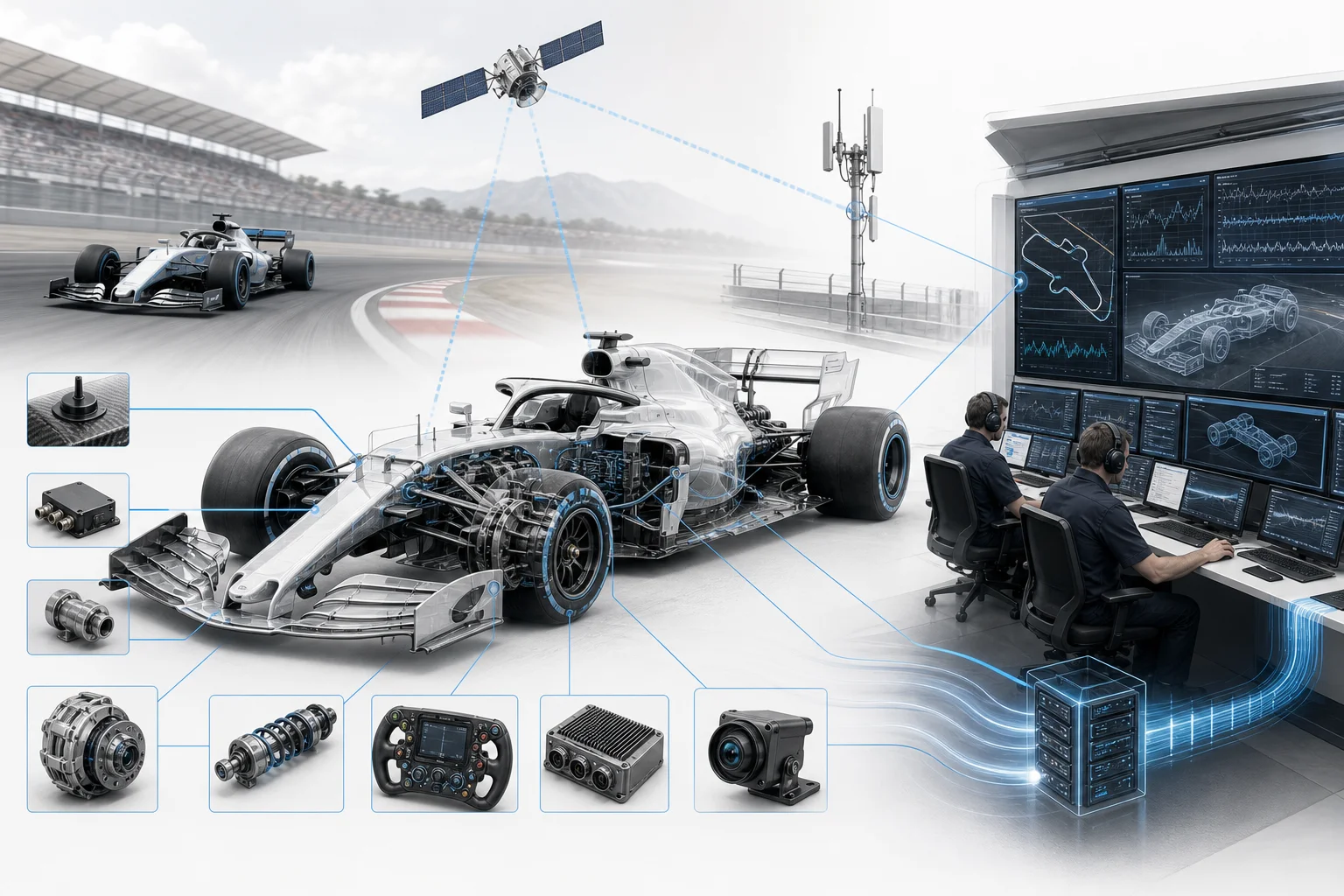
A modern GT3 or Formula car rolls out of the garage carrying hundreds of measurement channels, and every one of them has to be defined before the first lap. The engine control unit broadcasts its parameters over a CAN bus, while suspension potentiometers, strain gauges, infrared brake-temperature sensors, inertial measurement units and an RTK-corrected GPS receiver feed the logger through separate inputs. Sampling rates are chosen per channel, not globally:
- wheel speeds and throttle position usually run at tens of hertz;
- damper travel and brake pressure often sit at several hundred hertz;
- accelerometer and gyro data may exceed one kilohertz.
The discipline behind telemetry and real-time data analysis in professional motorsport starts exactly here — with a channel list, a scaling sheet and a calibration log. Get those wrong and the most beautiful dashboard in the paddock will still describe a car that does not exist.
Processing Motorsport Telemetry and Data
-
Define measurement channels and sensors
Engine control units, suspension potentiometers, and brake-temperature sensors are configured before the car rolls out. Every sensor requires a defined sampling rate tailored to its specific telemetry function.
-
Stream data to pit wall
Onboard loggers transmit hundreds of live channels across the wireless link directly to the pit wall. Engineers monitor these incoming real-time data streams continuously during every practice and race lap.
-
Compare incoming and historical laps
Data engineers evaluate current lap traces against previous baseline runs. This dual-read approach highlights immediate mechanical differences and areas where the driver gains or loses crucial time.
-
Filter reliable engineering metrics
Specialists focus strictly on trusted core numbers like tire degradation curves and core temperatures. Ignoring transient noise prevents false alarms during intense competitive sessions.
-
Execute strategy calls under pressure
Tactical decisions regarding pit stops and tire compounds rely heavily on live data feeds. Pit wall leadership uses immediate telemetry insights to react instantly to changing race conditions.
-
Correlate numbers with driver feedback
Objective sensor metrics are paired directly with subjective driver comments. This final alignment explains exact vehicle behavior that raw numbers alone cannot fully describe.
From Car to Pit Wall
Moving a value from a spinning wheel to an engineer's screen is a chain, and the weakest link sets the pace. On circuit, cars stream a compressed subset of channels through trackside antennas, microwave links or bonded cellular connections, while the full log stays on the internal logger for later download. Engineers talk about a latency budget the way brake designers talk about cooling: every stage — sensor, bus arbitration, on-car packaging, radio transmission, decoding, database write, plotting — eats a slice of the available time. Packet loss hurts more than raw throughput, because a dropped second of damper data cannot be reconstructed afterwards. Teams therefore rank channels, send rolling windows and push some processing onto the car itself. Public mobile networks around a stadium circuit are congested on race day, so many operations keep a dedicated radio path and treat cellular as a backup. When the link degrades, the pit wall notices instantly: a frozen trace during a pit stop is louder than any alarm on the screen.
Two Ways to Read Laps
Picture the classic routine: the car comes in, a mechanic plugs in a laptop, and the whole log downloads in the garage. Engineers then spend an hour or two scrolling through every channel at full resolution, comparing runs, while the driver walks over to look at the traces. Nothing is rushed, nothing is thrown away — and nothing helps the lap that has already happened. Now put the same lap on a live feed. Instead of the full logger dump, a few dozen channels arrive seconds after the car crosses the line: speeds, throttle, brake, gear, delta time, tyre temperatures. You see less, but you see it while the stint is still running, which is why telemetry and real-time data analysis in professional motorsport reshapes an entire weekend rather than just the evening debrief. The honest trade-off looks like this:
- post-session work gives depth — full resolution, every channel, forensic comparison;
- live analysis gives timing — enough signal to call a stop or soften a driver's approach.
Teams that win rarely pick a favourite.
Conditions and Parameters for Motorsport Telemetry
| Parameter Category | Operational Requirement |
|---|---|
| Sensor channel configuration | Hundreds of measurement channels defined before first lap |
| Engine data broadcasting | Parameters transmitted via standard CAN bus architecture |
| Sensor input diversity | GPS, strain gauges, and brake temperature sensors integrated |
| Channel sampling rates | Rates chosen per channel rather than globally |
| High-frequency data | Damper travel and brake pressure run at hundreds of hertz |
Numbers Engineers Actually Trust
Data earns trust slowly. A brake-temperature trace that reads plausibly can still be wrong if the infrared sensor's emissivity setting drifted after a disc change, and a suspension position channel looks perfect right up to the moment the potentiometer arm slips a tooth. Experienced crews build cross-checks into the system: GPS-derived speed against wheel speed, modelled fuel consumption against refuelling data, redundant pressure sensors that should agree within a narrow band. Automated plausibility alarms flag any channel that flatlines, spikes or stops updating, so an engineer spots a dead sensor before the driver reports a strange balance. Filtering is the other half of the argument — smoothing makes a trace readable but can bury a real oscillation, and every filter choice is a statement about what you believe is noise. Calibration logs, offset checks and pre-session health tests consume paddock time, yet they are what separates telemetry and real-time data analysis in professional motorsport from a wall of colourful graphs.
Strategy Calls Under Pressure
Strategy desks live on the edge of incomplete information. Fuel-saving targets, tyre degradation curves, pit-loss estimates and the gap to a rival two seconds behind all move at once, and the engineer must choose between an undercut attempt, an earlier stop or staying out for track position. Live data feeds that decision: throttle and brake traces show whether a driver is genuinely managing a tyre or simply losing pace, while GPS positions and timing loops reveal traffic and safety-car windows. Weather radar and track-temperature readings adjust the compound choice minutes before the car arrives. The craft lies in weighting these streams honestly — a degradation model built from Friday long runs may not survive a hotter Sunday, and a rival's sudden speed might reflect a different engine mode rather than fresh rubber. Good strategists treat telemetry as evidence rather than as an answer, and keep the driver's radio read in the loop.
Motorsport Telemetry FAQ
What parameters does <b>telemetry and real-time data analysis in professional motorsport</b> actually track?
How are sampling rates determined for different sensors on the car?
How does information travel from the moving vehicle to the pit wall?
Why do engineers rely on specific numerical values during practice and race sessions?
When are high-pressure strategy calls made using incoming data?
Where does driver feedback still matter alongside digital telemetry?
Bandwidth Rarely Decides the Race
Ask what limits live analysis and the instinctive answer is bandwidth. In practice the ceiling usually sits elsewhere. A modern link can move far more data than a human can interpret in the seconds between corners, so the real constraints become latency, channel selection and clarity of presentation. A trace arriving four seconds late is nearly useless for a coaching call, while a modest stream arriving instantly and rendered well can change a result. Edge computing shifts part of the job onto the car: compression, alarm generation, downsampling of channels nobody is watching. Teams also learn to transmit the right things — deltas and event markers instead of raw arrays. Regulation adds its own boundary, since series rulebooks limit what may be sent live and when. The engineering question, then, is not how wide your pipe is, but what deserves to travel through it during a green-flag run.
Regulations Shape the Data Pipe
Rulebooks define the plumbing as much as the engineers do. A championship with a spec ECU and a standard telemetry unit fixes which channels exist, how fast they are sampled and which of them may leave the car during a session. Some series permit live data only for safety and timing, keeping performance traces for post-session download; others allow richer streams to the pit wall but forbid sending certain information back to the driver. Loggers may be sealed after qualifying, and stewards routinely pull telemetry to check track limits, engine-mode usage or compliance with a penalty. The practical consequence is that telemetry and real-time data analysis in professional motorsport is a rules-driven discipline: a channel plan is written alongside the setup sheet, and engineers keep a record of what was transmitted and why. Series that restrict live coaching shift the value of data towards simulation, driver debriefs and the long-run analysis performed overnight.
Where Driver Feedback Wins
Sensors describe forces and positions; drivers describe sensations, and the two rarely arrive in the same language. A car can post identical damper traces while the driver reports a nervous rear over one particular kerb, and locating that mismatch is where the real work begins. Engineers learn to translate: "it goes light" becomes a ride-height or aero question, "the pedal is long" becomes a hydraulic or pad-wear check. Subjective comments also catch what instrumentation misses — a vibration felt through the wheel that appears as a faint, easily filtered oscillation, or a gearshift hesitation buried inside an averaged value. The strongest operations pair the two loops: the driver's words narrow the search, the traces confirm or kill the hypothesis, and the next run is designed as an experiment. Neither source is authoritative alone, which is why experienced race engineers still walk to the cockpit before opening another plot.