
Off-Road Safety Protocols and Preparedness
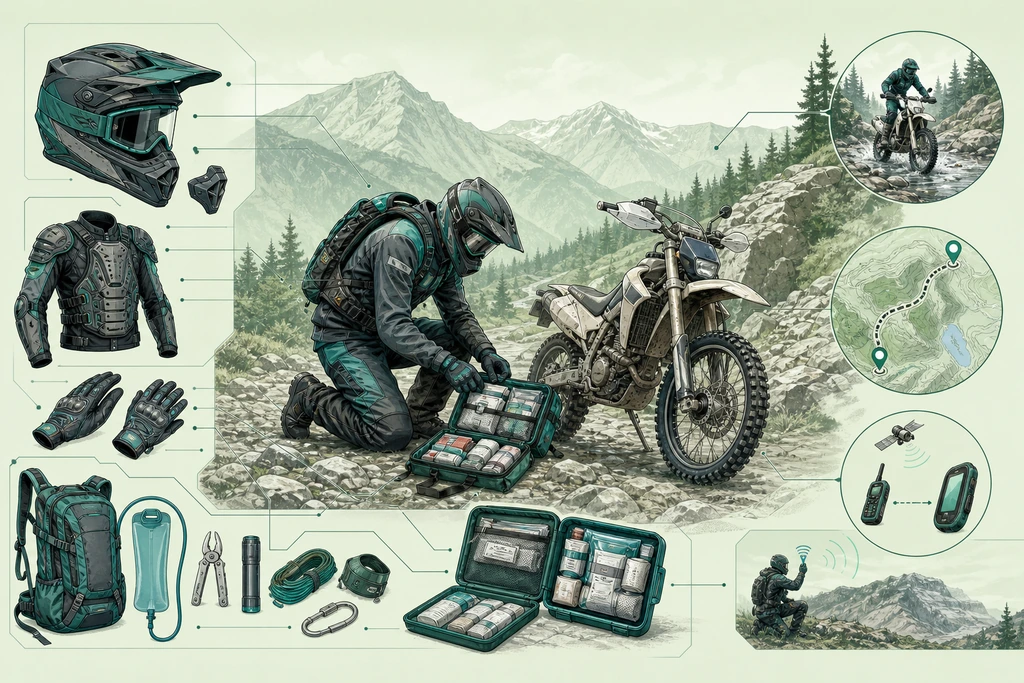
Navigating remote trails demands a rigorous approach to risk management and immediate response. This guide explores essential safety protocols and emergency preparedness in off-road riding, helping enthusiasts master hazard assessment, precise gear packing, and coordinated incident management. Learn how structured drills and administrative planning transform potential crises into controlled situations before you ever leave the pavement.
Safety Protocols and Emergency Preparedness in Off-Road Riding
-
Complete administrative pre-departure measures
File detailed route plans and expected return times with a reliable contact before leaving. Confirm all participant contact numbers and emergency contacts are documented accurately.
-
Pack two distinct kits
Separate medical supplies from survival gear into two dedicated kits. Ensure trauma supplies and communication devices are easily accessible on the machine.
-
Execute operational trail protocols
Maintain proper spacing, use pre-agreed hand signals, and appoint a lead and sweep rider. Avoid hazardous obstacles unless the entire group possesses proven capability.
-
Manage the incident immediately
Assign specific roles to group members within the critical first three minutes. One person secures the scene and treats the casualty while another prepares communication.
-
Establish precise coordinate reporting
Use satellite messengers and GPS devices to determine exact latitude and longitude before calling for help. Relay accurate terrain details to professional rescue dispatchers.
-
Administer tactical wilderness first aid
Stabilize fractures, control severe bleeding, and manage body temperature to prevent hypothermia during extended backcountry waits. Monitor vital signs continuously until evacuation arrives.
-
Practice regular emergency drills
Conduct periodic simulation exercises for breakdowns and injuries to build muscle memory. Reflex-based training minimizes panic and reduces response times during real incidents.
Three Minutes Decide the Outcome
Three minutes of delay at a remote trailhead can turn a sprained ankle into a hypothermic evacuation. That is the working premise behind every serious off-road program: the first quarter-hour after an incident matters more than the entire ride plan. In backcountry settings, professional rescue is typically 45 to 90 minutes away, and in alpine or desert terrain that window can stretch past two hours. Riders who accept this arithmetic plan differently. They carry a satellite messenger, they know their exact coordinates, and they assign one person to manage the casualty while another manages the route out. Distance is the real adversary, not speed. The closest ambulance is irrelevant if a locked gate sits between it and the trail. Two-way communication, a fixed check-in schedule, and a rider who stays with the injured party solve most of that gap. Everything else, including splints, tourniquets, and shelters, is secondary to getting help moving in the right direction.
Operational Protocols for Hazardous Trails
Every group ride needs a five-minute briefing that names a lead rider, a sweep rider, and a rally point. This is the least glamorous item on the list of safety protocols and emergency preparedness in off-road riding, and the one that most often prevents a bad afternoon. Concrete rules work better than encouragement. Fix the riding order before the engines are warm. Set a spacing rule: two seconds on open fire roads, four on blind corners. Agree on a hand signal for stopping immediately and a separate one for mechanical issues that allow keeping pace.
- Nobody rides alone off the main corridor.
- Every rider carries a charged phone and one backup power source.
- The sweep carries the group trauma kit, not the fastest rider.
Alcohol and fatigue disqualify a rider faster than any technical shortcoming because both slow reaction times measurably. If a rider cannot state the route, the rally point, and the bail-out road, the briefing was not finished. Before tackling technical terrain, ensure your setup includes reliable navigation-tools-and-gps-tracking-for to maintain your route in remote areas.
Packing Two Kits, Not One
A trailside repair kit and a trauma kit are two different boxes, and both belong on the machine. The mechanical side is predictable: tire plugs and a spare tube, a compact pump, a chain master link, zip ties, safety wire, and a multi-tool that fits every fastener you actually run. The medical side follows the same logic, meaning you buy for the injury you cannot improvise. A tourniquet, hemostatic gauze, an occlusive dressing, a splint, and an emergency blanket cover four killers in remote settings: bleeding, airway compromise, spinal injury, and hypothermia. Add two liters of water beyond what you plan to drink, electrolyte tabs, a headlamp, and a fire source that works wet. A satellite communicator with an SOS button is the highest-value item per gram, whereas a phone without coverage is merely a flashlight. Everything gets sealed in a waterproof bag and checked before the season, because expired gauze and corroded batteries fail silently.
Evaluating Off-Road Emergency Preparedness Strategies
| Preparedness Aspect | Standard Approach | Professional Protocol |
|---|---|---|
| Initial Incident Response | Wasting critical minutes during the first quarter-hour | Taking immediate action within the crucial three-minute window |
| Emergency Communication | Relying solely on standard mobile phone coverage | Carrying satellite messengers with exact coordinate tracking |
| Medical Supply Management | Packing a single combined general utility kit | Dividing supplies into two distinct survival kits |
| Team Role Assignment | Unorganized response by all available group members | Assigning one manager for the casualty and one for communications |
| Pre-Departure Administration | Skipping route registry and emergency contact checks | Completing thorough departure checklists and tracking plans |
When a Rider Goes Down
When someone is down, the first rider on scene controls the scene, not the patient. Stop traffic, kill engines, and post a marshal uphill and downhill if the crash sits on a blind section. Then run a fast assessment covering responsiveness, breathing, and catastrophic bleeding, in that exact order. Do not pull off a helmet unless the airway is blocked and no alternative exists; the same restraint applies to boots and spinal alignment. Keep the casualty warm before you move them. Ground chill drains heat faster than air temperature suggests, so insulation goes underneath as well as on top. One person talks to the injured rider continuously and records times, symptoms, and any medication given. Meanwhile, a second rider establishes contact with rescue, reads coordinates from a GPS rather than describing scenery, and identifies a landing zone if air evacuation is likely. Decisions about moving a casualty belong to professionals, or to a real, immediate threat.
Administrative Measures Before Departure
Preparedness is administrative long before it is physical. Someone at home should hold the route, the expected return time, and the vehicle description, because a plan nobody else can access does not exist. Register the satellite device with a current contact list and test the SOS function according to the manufacturer schedule. An unregistered beacon routes to a call center that cannot reach your emergency contacts. Check local rescue numbers, land-manager rules, and whether the area has a volunteer medevac service worth a membership fee. Weather gets a second look at the trailhead, not only at home, because mountain forecasts shift within 12 hours. Experts advise keeping a written card in the tank bag detailing blood type, allergies, medications, and two phone numbers, since paper survives a dead battery. Review insurance coverage for off-road injury and evacuation, because many policies exclude motorized recreation outside maintained roads. That paperwork is the unglamorous half of safety protocols and emergency preparedness in off-road riding.
Essential Off-Road Safety Guidance
Critical survival window after crashes
Operational protocols for hazardous trails
Mandatory dual kit packing strategy
Drills Build Reflex, Not Fear
Skill fades without repetition. A rider who has never applied a tourniquet one-handed will fumble it under stress, and stress arrives with the injury. Schedule short, boring practice: two minutes to locate and open the trauma kit blind, sixty seconds to pack a simulated wound, and a full five-minute scenario that includes calling for help and reading coordinates aloud. Practice lifting a fallen bike correctly, keeping knees bent and back flat while using the handlebar and subframe as grips, because exhaustion causes as many evacuation problems as fractures. Then rehearse self-rescue by righting a bike alone, plugging a tire in the dark, and walking out on a marked bearing. Group scenarios expose the real gaps, such as nobody assigned to communications, no agreed rally point, or kits buried under heavy luggage. Run one drill per month and rotate the role of incident leader so every rider learns to give orders without shouting. Hesitation, not bad luck, explains most slow responses in the field. Mastering these emergency drills ultimately fuels the-global-passion-for-racing, allowing riders to transition safely from local trails to competitive environments.