
Evolution of Track Designs and Terrain Challenges
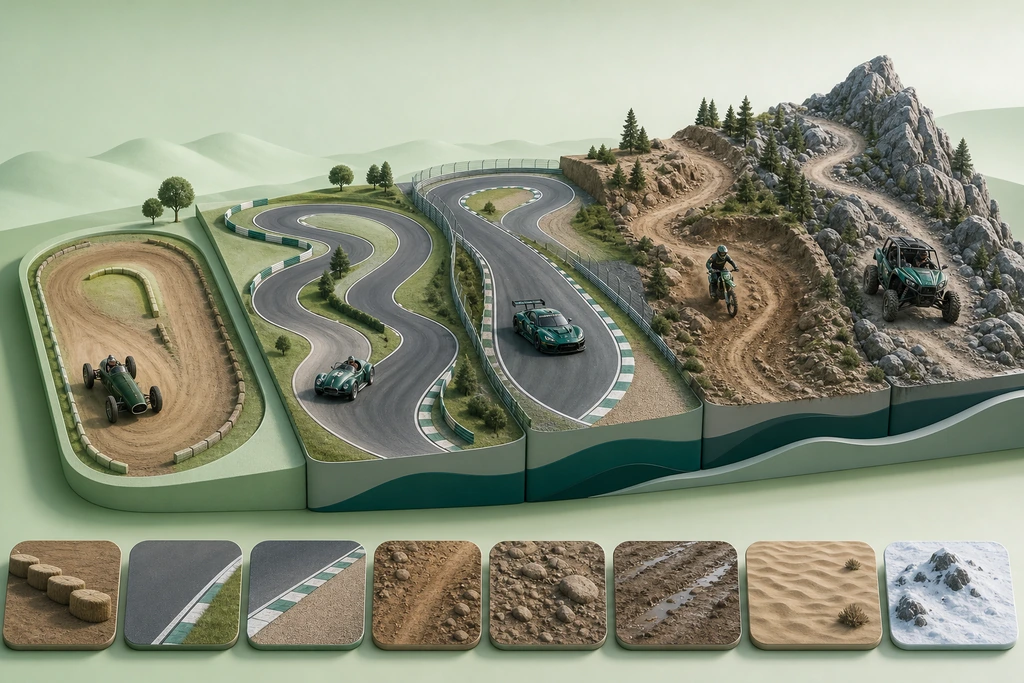
Motor sports have long been shaped by the physical realities of the earth and the ingenuity required to conquer it. From early wooden boards and brick ovals to modern point-to-point stages and desert dunes, the evolution of track designs and terrain challenges reveals how engineers and drivers adapt to shifting grip levels, severe weather, and relentless mechanical demands.
Dirt ovals set the baseline
Early motor racing borrowed its geometry from horse tracks and bicycle velodromes to handle early competitive needs. Brooklands, opened in 1907, used 30-foot-high concrete banking around a 2.75-mile loop; Indianapolis laid 3.2 million bricks in 1911 over a rectangular 2.5-mile oval. Wooden board tracks in the 1910s pushed speeds past 160 km/h on planks, and nearly every one of them failed within a decade because rain and repeated load cycles destroyed the surface. Dirt ovals survived longer simply because grading was cheap: a crew with a scraper could rebuild a corner overnight. That economic logic — surface renewal cost measured against cornering speed — still drives the evolution of track designs and terrain challenges today. Almost nothing in the early rulebooks addressed drainage, camber or run-off; promoters relied on the ground itself to sort the fast from the unlucky.
What terrain demands from chassis engineers
Spa-Francorchamps drops 102 metres between its highest and lowest points. The Nordschleife covers roughly 300 metres of vertical range across 20.8 kilometres. Bathurst climbs and falls 174 metres per lap. Numbers like these explain why a chassis engineer cannot treat asphalt as a flat plane. Gradient changes load transfer, and load transfer sets spring rates before a single aerodynamic part is drawn. Then soil bearing capacity decides how deep the sub-base must go; a circuit laid on clay needs different drainage from one on chalk. Camber adds another constraint: a corner banked at 12 degrees carries far more speed than a flat one, yet it loads the outside tyres asymmetrically and demands specific kerb profiles. On loose surfaces the same variables multiply, because the surface itself moves under load. Engineers do not design a car and then go looking for a track; the ground writes a large part of the specification first. Suspension geometry must adapt dynamically to prevent bottoming out on severe compressions. Optimizing power delivery across varied terrains requires proper basic-engine-tuning-and-fuel-efficiency to maintain consistent throttle response under heavy loads.
Four grades, one rulebook
Circuit licensing runs on four FIA grades, and the differences are physical rather than bureaucratic. Grade 1, required for Formula 1, sets a minimum width of 12 metres, a lap length between 3.5 and 7 kilometres, prescribed run-off dimensions scaled to approach speed, and barrier standards such as TecPro blocks backed by concrete. Grade 2 covers most international car and motorcycle championships; Grades 3 and 4 handle national and club events with shorter run-off and narrower surfaces.
- Gravel traps slow a car roughly in proportion to bed depth, but they punish motorcycles severely.
- Asphalt run-off preserves grip for cars yet encourages aggressive track-limit abuse.
- Kerbs above 50 mm destabilise low cars and injure riders on impact.
That last point explains why motorcycle venues often demand more paved run-off than car circuits, an inversion that surprises promoters. Inspectors re-measure everything every few years, and resurfacing alone can drop a circuit by a grade if drainage or barrier geometry no longer fits the current speed profile.
Grip is a contract with the surface
Grip is a contract between rubber and surface, and either side can break it under extreme loads. Asphalt is not one material but a mix: aggregate size, angularity and bitumen grade determine macrotexture, and macrotexture decides how fast water escapes from under a tyre contact patch. A coarse mix drains well but wears rubber quickly. A fine mix offers peak grip in the dry and turns glassy in rain. Circuits therefore resurface on cycles driven by polishing rate rather than by visible cracks; Silverstone has been relaid several times in two decades because high-downforce cars polish the racing line. Dirt and gravel behave the opposite way. The surface deforms, so grip depends on how the tyre shears loose material, not on molecular adhesion. Ice and packed snow cut the coefficient to a fraction of asphalt values, which is why winter events run on studded rubber. Every change of material shifts braking points, and braking points rewrite the logic of a layout.
Point-to-point racing broke the template
Point-to-point racing broke the oval template because it refused to repeat a corner. The Targa Florio, first run in 1906, used 72 kilometres of Sicilian mountain roads; the Mille Miglia covered roughly 1,600 kilometres of Italian highways between 1927 and 1957. Neither could be inspected for consistent run-off, so organisers substituted distance for precision. The Monte Carlo Rally, from 1911, added weather and altitude as design variables, and the Safari Rally turned surface unpredictability into the entire product. Group B ended in 1986 after spectator deaths proved that open-road formats could not be sterilised. Modern rallying answered with closed special stages, pace notes and homologated safety cages. The evolution of track designs and terrain challenges runs through public roads as much as through purpose-built circuits. Planners now measure gradient, water crossings and bedrock before a stage is signed off, and one impassable ford can delete twenty kilometres of route.
Two wheels, same terrain challenges
A motorcycle and a car want different things from identical ground. A bike carries its line through a wide arc and uses most of the track width, so a surface that suits a car's narrow racing line may still unsettle a rider at lean angles beyond 50 degrees. Bikes also dislike camber changes mid-corner and vertical bumps at the apex; a car's suspension absorbs them, a rider's body does not. That is why MotoGP venues such as Jerez and Mugello keep kerbs low and run-off wide and paved, with air fences replacing tyre stacks in the highest-risk zones. Homologation reflects the split: FIM standards assess run-off in metres relative to lean angle, while FIA grades focus on deceleration distance for a four-wheeled vehicle. Track width stays comparable, between 12 and 15 metres, but usable width differs significantly. Riders brake later into a wider entry, so a corner designed around cars will often produce processional racing on two wheels.
Dunes, altitude and the Dakar calculus
Desert racing measures terrain in cost per kilometre. The Dakar Rally spent 2009 to 2019 in South America, crossing Andean passes above 4,000 metres where naturally aspirated engines lose roughly 3 percent of output per 300 metres of altitude; petrol-engined T1 cars consequently surrendered about a fifth of their power on the Bolivian stages. Organisers moved the event to Saudi Arabia in 2020, trading altitude for dune fields and soft sand that punish tyre pressures and cooling. A stage of 800 kilometres combines several surfaces in a single day: rocky pistes that destroy sidewalls, fesh-fesh dust that clogs filters, and dunes where momentum replaces grip. Navigation, not speed, decides results — a navigator reading a roadbook at 120 km/h has roughly four seconds to identify a waypoint. Vehicle design follows the ground: wider tyres, suspension travel near 300 mm, and cooling packs mounted high to survive extreme desert dust.
Nobody budgets for drainage until it rains
Resurfacing a Grade 1 circuit costs millions, and most of that money goes under the asphalt rather than onto it. A modern layout carries a drainage network sized for a defined storm return period, longitudinal and transverse falls of roughly 1 to 2 percent, and sub-base layers that must survive frost and heavy axle loads. Skip that, and a wet race exposes the omission on live television; the shortened 2021 Belgian Grand Prix remains the standard example. Design offices now laser-scan terrain before drawing a single corner, then test gradients in simulation to see where water will pool and where a car will bottom out. Simulation has not replaced surveying; it has made bad ground cheaper to discover. Track engineers track these specification changes as circuits are re-homologated, because the evolution of track designs and terrain challenges is now driven as much by climate data and maintenance budgets as by lap times.
Evolution of Track Designs and Terrain Challenges
| Track Era | Surface Material | Terrain Challenge | Engineering Impact |
|---|---|---|---|
| Early Oval Tracks | Wood and Bricks | High banking and tight loops | Frequent surface failure from weather |
| Dirt Ovals | Compacted Soil | Loose surface and erosion | Cheap grading and nightly repairs |
| Point-to-Point | Natural Roads | Unpredictable elevation and obstacles | Custom suspension setups for endurance |
| Cross-Country Rally | Sand Dunes and Mud | Extreme altitude and soft terrain | Enhanced chassis and cooling demands |